The AI Merchandiser, Act 2: The Winning Strategy
The winning strategy for influencing AI product discovery is to treat merchandising as signal design with rich and trustworthy content that gives AI the confidence to recommend your products.
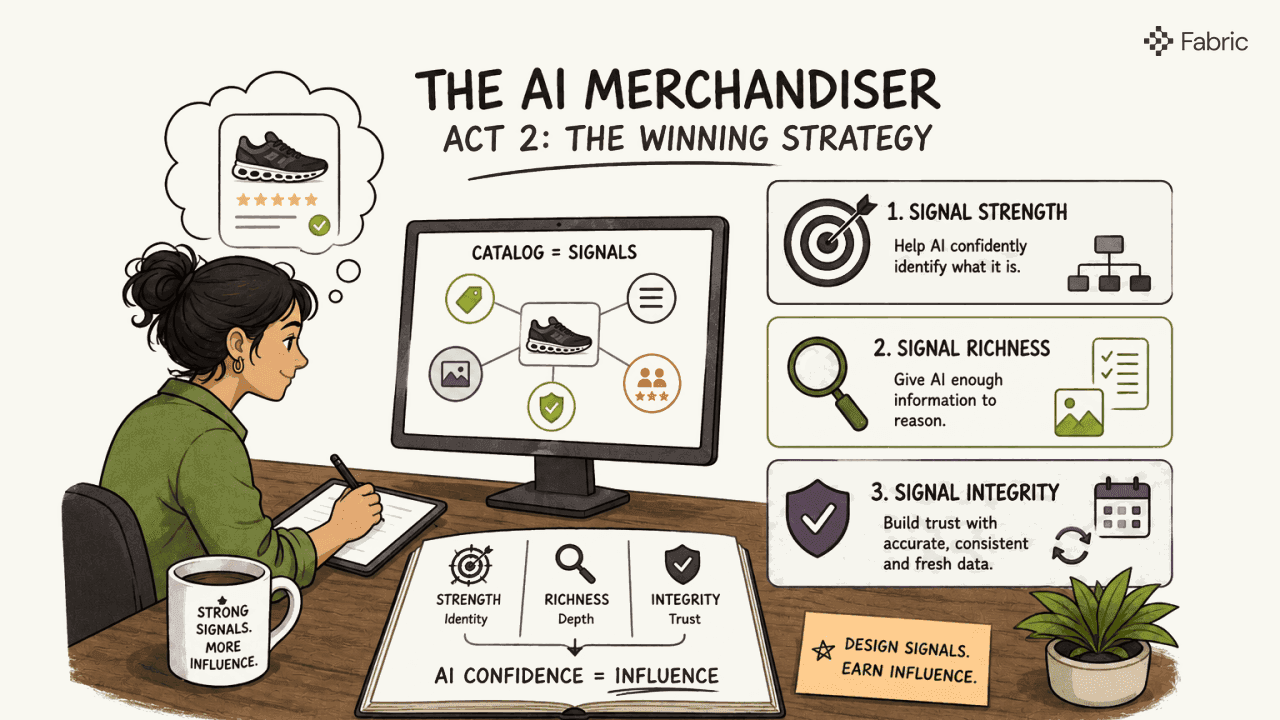
Here it is: The winning strategy is treating merchandising as signal design.
Let me explain.
In a world where AI increasingly controls influence over product selection, merchandisers are becoming the architects of signals that determine whether products are discovered, understood, and recommended.
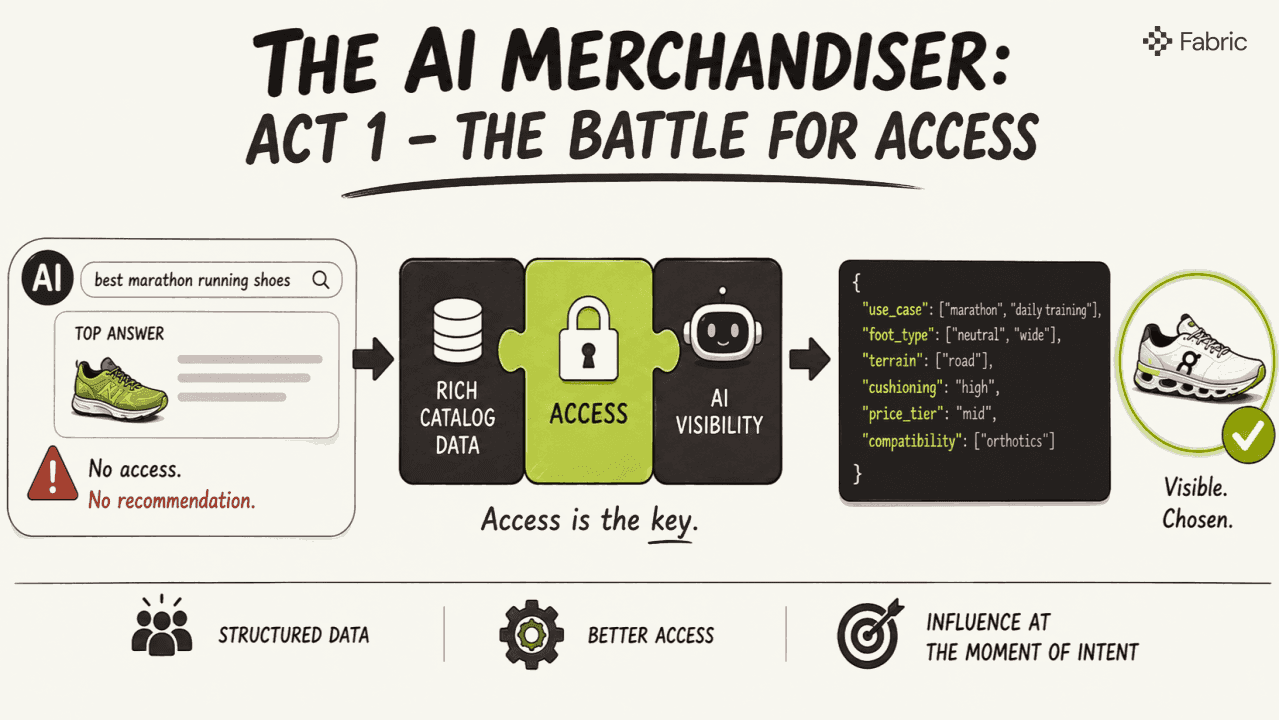
In “Act 1: The Battle for Access” I argued the first priority for every merchandiser in this AI era of product research and discovery is ensuring that LLMs can access your catalog via rich, structured product data in your page schema. Products stand a much higher chance of being surfaced in an answer if the search agents can easily identify, read and understand your catalog.
Now, think of the catalog as a collections of signals that AI uses to form confidence. And confidence is the key variable in shaping influence.
For example:
- Bad categorization weaken signals.
- Thin attributes weaken signals.
- Contradictions corrupt signals.
- Stale products poison signals.
The role of the merchandiser has moved beyond page optimization. The AI merchandiser is designing signal optimization.
We’ve learned this first hand. I’ve pulled together examples that we’ve observed over the past six weeks supporting merchants as they optimize catalogs for AI agent access and navigate early agentic commerce strategies.
There are three ways to think about merchandising as signal design.
- Signal Strength > Categories and Variants
- Signal Richness > Attribute Depth, FAQs, Image Alt Text and User Validation
- Signal Integrity > Accuracy, Freshness and Consistency
Let’s dive in.
(1) Designing for Signal Strength
Can AI confidently identify what this product is?
AI search retrieves products by meaning, not navigation. This is a critical takeaway from our research and observed reality testing on LLMs. When we work with customers and get an initial catalog dump, the first order of business is making sense of the merchant’s taxonomy. If we can’t understand it then there’s no way an AI agent will.
While traditional ecommerce merchandisers optimized catalog structures for humans to browse, LLMs use them as evidence to infer what a product is. Take these two examples:
Categories
Working with a home goods brand we evaluated approximately 4,000 SKUs. Roughly 60% of them sat under three top-level categories. This hierarchy is fine for browsing but agents struggle to match distinct intent signals within a prompt to the right category.
On this merchant’s site the “Home” category contains a broad mix of products with categories appearing in multiple locations within the taxonomy. A “ceramic pour-over coffee dripper” appears in multiple places leading to confusion by an agent. Is it a home good? A kitchen appliance? An Accessory? All of the above? Here’s what we did:
From: (L1) Home > (L2) Home Accessories
To: (L1) Home > (L2) Prep, Gadgets & Accessories > (L3) Coffee & Beverage
The canonicalization of the product into semantic categories produces a better, more context rich result that also implies intended use.
We’ve found that broad category types also create weak facets for onsite search and force customers to wade through long result sets. As the catalog grows generic types become progressively less usable to AI agents.
We worked to re-classify products at the most appropriate level of specificity while staying consistent with their taxonomy. This supports better search recall and precision, more useful facets, tighter merchandising control and observed more consistent recommendations by AI agents.
Variants
Another common challenge for establishing signal strength is in variant handling. One catalog represented a single sneaker as 14 independent products, one for every colour. Humans understand they’re looking at the same shoe as they click through variants.
But, AI sees fourteen nearly identical products competing with each other. Instead of accumulating evidence around one product, every variant dilutes the overall signal. The stronger approach is to model products using parent-child relationships. This isn’t a new concept but it’s a critical point that weakens signal strength to AI agents.
The parent communicates what the product fundamentally is: On Running, Cloudmonster 3
Children communicate the shopper’s choices:
- Color
- Size
- Width
- Material
The parent / child relationship structure concentrates semantic evidence around the parent while preserving the attributes customers care about. It also mirrors how shoppers think.
People might prompt for: “On Cloudmonster 3 Blue Size 10”
We see they typically search for: “Cushioned marathon running shoe for wide feet.”
The agent identifies the parent product first then determines which child variant satisfies the customer’s preferences. Well-modelled variants allow AI to recommend the product confidently while still matching the right size, color, or configuration.
Signal strength is about identity. Can an agent identity a product and it’s intended use. Taxonomy and variant handling are just a couple ways to ensure agents understand your products by mapping to universal categories and define options that match customer intent upon query.
(2) Signal Richness Comes from Semantic Depth
Once AI knows what the product is, does it have enough information to reason about it?
Signal richness is about semantic depth. Producing deep product information is a tale as old as time. Supplier sends sparse product data, category managers, merchandisers or detailers all hustle to fill in information, product images, descriptions, etc. Top sellers get more attention while others pass with a handful of attributes, a basic description and are merchandised to improve visibility on the storefront.
But, in this AI search game where influence happens in a chat box, semantic depth is essential to all products.
Here are a handful of examples:
Attribute Depth — Working with one apparel company we saw color attributes as “midnight,” “ocean,” and “indigo” used across products that were all, functionally, blue. A human understands this while an agent is mapping to a prompt for “blue” and finds nothing. Controlled vocabulary is the line between filterable and invisible.
Descriptions — One customer had an entire product line that shared a single copy-pasted description. Nothing differentiated item from item so the agent had nothing meaningful to reason over.
Titles — We saw product titles carrying internal codes (SKU-2724-BLK-V3) instead of meaningful names. Humans ignore the noise while agents read every character. These titles dilute the product’s identity.
FAQs — FAQs are often the richest source of shopper language because they capture the questions customers ask before purchasing. If it matters enough to be an FAQ, it matters enough for AI to understand. This is where context can be added to a product and served to an agent to parse, reason and respond.
Images / Image Alt Text — We come across many images that don’t match attribute values for color. For example, a “green” value assigned to the color attribute while the image showed a red product highlights the importance of visual metadata. Image tags and alt text give agents reliable semantic context instead of assuming it’ll correctly interpret imagery.
Brand Voice — One luxury brand’s catalog read like a specification sheet. The agent described every product accurately but generically. Without expressive merchandising copy, the brand lost its personality in AI-generated recommendations.
We’ve confirmed through our experience with these customers that LLMs don’t retrieve products because they have data, they retrieve products because they have enough evidence to reason over. It’s a subtle but important distinction.
For years, merchandisers optimized products for three things: Search indexing, filters and conversion.
LLMs introduce a fourth objective: Reasoning.
A shopper no longer asks: “Show me blue jackets.”
They ask: “I need a lightweight waterproof jacket for hiking in the Pacific Northwest that packs into a carry-on.”
Now the model has to infer suitability. That requires semantic depth.
(3) Signal Integrity Builds Trust
Can AI trust the signals it’s receiving?
The AI merchandiser must work to build confidence with LLMs and it starts with trust. There’s a bit of fallacy that AI is smarter than humans. In agentic search / commerce it’s likely the opposite. AI is less forgiving than humans because we are able to better manage through messy data and experiences. We can ignore contradictions and reason through ambiguity. At this stage of AI inference, AI doesn’t ignore messy information, they simply lose trust it.
These final set of observations surprised us because we expected to spend our time enriching catalogs for AI visibility but instead we spent a lot of time resolving contradictions.
Stale & Placeholder Records — We’ve seen a spring catalog still serving holiday products alongside “Product Title Here” placeholders. The catalog was very large and thus had a few live products get lost. But again, a human skips over dead inventory while an AI agent recommends it. Fool me once, shame on your, fool me twice and ChatGPT loses confidence.
Contradictions — We’ve seen enough titles, specifications, attributes, and imagery contradictions to work this into our UI by flagging where inference is low confidence. It’s a common enough mistake that it’s worth having a feature to callout miss-match data within customer content. AI treats these contradictions as conflicting evidence that lowers confidence and makes products less discoverable.
Freshness — Finally, we see outdated assortments, unavailable products, and expired merchandising content. This becomes a recommendation risk for LLMs. Freshness isn’t just operational hygiene anymore, it’s part of discoverability.
Signal integrity is pivotal because AI doesn’t just consume information like humans, it weighs it. Every conflicting signal introduces uncertainty, every stale record lowers confidence and every inconsistency becomes another reason to recommend a different product instead.
In Conclusion
For the last twenty years, merchandising has largely focused on optimizing experiences for people: Category pages, site search, product grids, promotions, recommendations, etc.
The AI era doesn’t replace those responsibilities but it does change where influence happens.
When product discovery begins with a conversation instead of a storefront then the catalog becomes the experience. Every category, every attribute, every image, every FAQ and every product description becomes a signal that helps AI determine whether your products deserve to be recommended.
That’s why I believe the role of the merchandiser is evolving. The AI merchandiser is designing signals.
Strong signals help AI identify products with confidence. Rich signals give AI enough context to reason over them. Trustworthy signals give AI the confidence to recommend them.
And confidence is quickly becoming the currency of influence in agentic commerce.
If you made it this far, thank you! If you like this series then stick around for “The AI Merchandiser, Act III: The Fate of Measurement” where I’ll discuss attribution and the muck we’re all wading through in this industry to understand the impact of our strategies.